How to Find a Job As An Executive Function Coach


Are you wondering whether executive function coaching can actually become a real career path?
In this post, you’ll learn where executive function coaches find work, why many eventually build private practices, and what it takes to create a sustainable coaching career in a growing field.
Table of Contents:
It may surprise you to learn that many people discover executive function coaching by accident.
Sometimes, it starts with a teacher realizing they spend more time helping students manage their overwhelm than actually teaching content.
Other times, it’s a counselor who notices that a student’s biggest problem isn’t intelligence, but consistently getting started, staying organized, or following through.
Other times, it’s a parent or professional hearing the term “executive functioning” for the first time and suddenly having language for challenges they’ve been seeing for years.
Then comes the next question: can you actually build a career doing this?
The answer is yes, but not always in the way people initially expect.
Executive function coaching is still a relatively young field, which means there is no single, standardized career path.
Some coaches work for established academic coaching companies or educational support organizations, while others partner with schools, therapists, or disability support programs.
Many eventually create private coaching practices of their own like our EFCA graduates who got certified and now run thriving practices.
And increasingly, more professionals are realizing that building an independent coaching practice may offer more flexibility, autonomy, and long-term opportunity than trying to fit into a traditional employment model alone.👇
Executive Function Coaching Careers Rarely Follow A Traditional Path
Unlike careers with highly formalized hiring pipelines, executive function coaching tends to grow organically from existing experience.
Many people entering the field already have backgrounds in education, counseling, student support, intervention, tutoring, or psychology.
In many ways, they’ve already been helping people with executive functioning for years.
They just weren’t calling it that yet.
That overlap makes sense because executive functioning challenges appear constantly in both academic and professional environments.
Students struggle to:
plan large assignments
manage deadlines
regulate frustration
prioritize tasks
or transition between responsibilities
Adults often experience similar challenges in workplace settings, especially those with ADHD or other neurodivergent profiles.
Executive function coaching takes those recurring challenges and approaches them systematically.
Instead of focusing primarily on academic content or productivity hacks, coaching helps people build sustainable systems to manage daily responsibilities more effectively.
For professionals who may already be working closely with students or adults, the transition into coaching often feels surprisingly natural once they develop formal coaching frameworks and methodologies like the repeatable framework to run coaching sessions I teach in the certification program.
Where Executive Function Coaches Actually Find Work
One reason people sometimes struggle to “find executive function coaching jobs” online is that opportunities are often scattered across multiple industries rather than housed under one obvious category.
It’s not as easy to find a job for an executive function coach on Indeed as it might be, say, to quickly Google “dental hygienist jobs” and be immediately presented with 15 jobs in your vicinity that perfectly match your skillset.
So where do you start?👇
Some coaches begin by working for established coaching organizations that support students with ADHD, learning differences, or academic challenges.
That’s a wise move, given that this need continues to grow rapidly.
According to the CDC, approximately 11.4% of U.S. children ages 3–17 have been diagnosed with ADHD, a condition strongly associated with executive functioning challenges.
And that’s to say nothing of other students with executive functioning challenges, or even adults who need support.
Starting with an established coaching company is one option, as they provide:
client referrals
session structures
administrative systems
and virtual coaching opportunities
all of which can be helpful for newer coaches building experience.
Other people may find opportunities inside schools, colleges, disability support programs, or learning centers.
Either way, executive functioning support has become increasingly important at the secondary and college levels because students are expected to manage far greater independence than many have been prepared for.
At the same time, private referrals continue growing rapidly.
Parents, therapists, psychologists, and educational consultants are actively searching for professionals who understand executive dysfunction, especially for students who need more individualized support than schools can consistently provide internally.
This is where many executive function coaches eventually begin shifting toward independent work, and this is exactly where the EF Coaching Certification Program can help launch and grow your practice.
Why So Many EF Coaches Eventually Start Private Practices
Working for an established coaching company can absolutely be valuable, especially early on.
It allows coaches to gain experience, refine their process, and better understand client needs.
But executive function coaching is also uniquely suited to independent practice.
The work itself is highly personalized.
Coaches often develop specialized approaches based on the populations they work with most closely, whether that’s autistic students, college students with ADHD, twice-exceptional learners, or adults struggling with workplace organization and burnout.
Over time, many coaches often realize they want more control over:
the types of clients they work with
their coaching schedules
session structure and methodology
pricing and income potential
virtual versus in-person services
long-term business growth
For example, according to our 2026 Industry Report, 7% of EFCA graduates make $10,000+ per month in income from their coaching practices!

And because executive function coaching can often be delivered virtually, the barriers to starting an independent practice are lower than many people expect.
That doesn’t mean building a coaching business is effortless.
Coaches still need strong systems, communication skills, referral relationships, and professional credibility.
But unlike some professions that require major infrastructure or physical offices to begin, executive function coaching can often scale gradually and sustainably over time.
For many professionals, that flexibility becomes one of the field’s biggest advantages.
Executive Function Coaching Is Growing Because The Need Is Real
Executive functioning affects far more than grades or productivity.
It affects how people:
manage stress
organize responsibilities
regulate emotions
start tasks
recover from setbacks
and function independently in everyday life
Research published in Frontiers in Psychology found that executive functioning skills are among the strongest predictors of academic success, often more predictive than IQ alone.
As awareness around ADHD, autism, neurodivergence, and executive dysfunction continues to grow, more families and adults are recognizing that these challenges require direct support, not just reminders to “try harder.”
This is especially evident at the college level, where students are suddenly expected to manage a greater degree of independence with far less external structure.
At the same time, schools and educational systems are increasingly stretched thin.
Many professionals working inside those systems already know students need more personalized support than schools alone can realistically provide consistently.
Executive function coaching helps fill that gap.
And because the field itself is still expanding, professionals entering now have an unusual amount of flexibility in shaping what their careers ultimately look like.
Building A Sustainable Coaching Career Requires More Than “Being Good With Students”
One of the biggest misconceptions about executive function coaching is that strong interpersonal skills alone are enough to cut the mustard.
And while relationship-building matters enormously, sustainable coaching also requires understanding how executive functioning challenges actually operate in real life.
A coach needs to understand:
why a student may freeze when starting assignments
why transitions trigger overwhelm
why emotional regulation affects follow-through
or why traditional productivity systems completely fail some neurodivergent clients
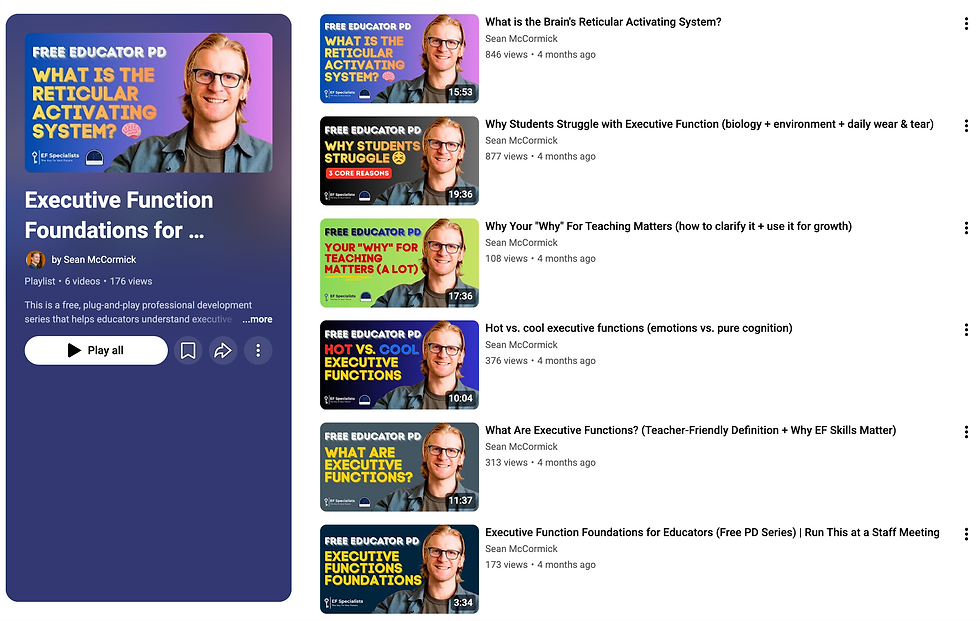
A great place to start understanding these is my Executive Functions Foundations playlist.👇
Good coaching is highly individualized, and involves identifying breakdown points, reducing friction, building realistic systems, and helping clients develop long-term independence gradually over time.
That’s one reason why professional training is so important.
The coaches who tend to build long-term careers in this field are usually the ones who combine strong communication skills with structured coaching frameworks, neurodiversity-informed approaches, and practical systems clients can actually sustain.
Executive Function Coaching Offers Multiple Career Paths
One of the most appealing parts of executive function coaching is that it doesn’t lock professionals into one rigid model.
Some coaches prefer school-based or organizational roles with more structure and steady referrals.
Others eventually move into fully independent private practice, while some combine coaching with teaching, counseling, consulting, or educational advocacy work.
There’s also increasing demand for coaches who specialize in specific populations or challenges rather than trying to serve everyone broadly.
For example, coaches may focus specifically on:
autistic students
college transition support
adults with ADHD
workplace executive functioning
twice-exceptional learners
emotional regulation and planning systems
That specialization often becomes extremely valuable because clients are actively searching for professionals who deeply understand their particular challenges.
And in many cases, coaches discover that building a private practice allows them not only to create more flexibility professionally, but also to have greater control over the kind of support they provide.
Learn How To Build An Executive Function Coaching Career
At the Executive Function Coaching Academy, educators, student support professionals, and aspiring coaches receive training in executive functioning support strategies, coaching methodologies, and support in launching your private practice.
For many professionals, executive function coaching represents more than just a career shift, but also presents the opportunity to build meaningful, flexible work centered around helping people function more effectively in daily life.
Whether you’re interested in joining an established coaching organization, expanding your current professional role, or building an independent coaching practice of your own, executive function coaching is a field with growing demand and significant long-term opportunity.
If you're interested in starting your own private practice, you can take the simple next step of applying for certification here.

And remember: as the demand for executive function coaches continues to grow, there’s a wonderful opportunity for meaningful work, work that genuinely helps people build lives they can be proud of.
Hope this helps! 🤙🏼
FAQs
What types of clients do executive function coaches work with?
Executive function coaches may work with middle school students, high school students, college students, adults with ADHD, autistic students, twice-exceptional learners, and professionals struggling with organization, planning, or time management challenges.
Is executive function coaching a growing career?
Yes. Demand continues growing as awareness around ADHD, autism, executive dysfunction, and neurodivergent support increases. More families, schools, colleges, and adults are actively seeking individualized executive functioning support.
Can teachers become executive function coaches?
Absolutely. Many executive function coaches come from education backgrounds because teachers already spend significant amounts of time helping students manage planning, organization, emotional regulation, and task completion challenges.
This article is a part of the larger category of:
Related Articles:
2026 State Of The Executive Function Coaching Industry: Data And Statistics from EFCA Graduates
Why I Quit My Career As A Special Education Teacher And What I Do Now
How Jordyn Shapiro Leveled Up Her Tutoring Company With Executive Function Coaching
How Sarah Zeilstra Built Her Executive Function Coaching Business While Teaching Full-Time
Want support in transitioning to executive function coaching?
Consider joining hundreds of educators and professionals who have completed our executive function coaching certification and are building profitable executive function coaching practices using their teaching experience.
You'll gain all the tools, templates, and techniques you'll need as a coach, plus you'll make new friends and have a community you can rely on to grow and learn. Learn more.
Here is one of our favorite reviews. You can read all recent reviews on this page.
About Me

Hey! I'm Sean 👋
I'm a former public school special education teacher who realized that executive function skills are more important than knowing when George Washington crossed the Potomac.
Since then, I've made it my mission to teach anyone who will listen about how to develop these key life skills.
In 2020, I founded Executive Function Specialists to ensure all students with ADHD and Autism have access to high-quality online executive function coaching services. We offer online EF coaching and courses to help students and families.
Realizing I could only reach so many people through coaching, in 2021 I started the Executive Function Coaching Academy which trains schools, educators, and individuals to learn the key strategies to improve executive function skills for students.
In 2023, I co-founded of UpSkill Specialists, to provide neurodivergent adults with high-quality executive function coaching services.
When not pursuing my passions through work, I love spending time with my family, getting exercise, and expanding my brain through reading. You can connect with me on LinkedIn.