2026 State Of The Executive Function Coaching Industry: Data And Statistics from EFCA Graduates

Updated: May 18
Thinking about becoming an executive function coach can bring up a lot of questions about money, flexibility, confidence, and whether this career path is actually worth it.
In this article, we’ll break down what EFCA-trained coaches are charging, earning, working, and experiencing so you can see what becoming an executive function coach really looks like in 2026.
If you don’t know what an executive function coach is, it’s someone who helps students, adults, or families strengthen skills like planning, organization, time management, emotional regulation, and follow-through so they can feel more confident and independent in daily life.
For more on what an executive function coach does, check out this article.
About this data: This survey reflects responses from 36 executive function coaches who got certified through EFCA and have been coaching for six months or more.

Table of Contents:
If you're considering a career as an executive function coach, you’ve probably wondered:
Can I make a real income doing this?
What’s the workload like?
Is it actually fulfilling?
We surveyed graduates of the EFCA Executive Function Coaching Certification Program who are actively working in the field to bring you an honest, data-driven snapshot of what this career looks like.
Let's get into the numbers.👇
Who Becomes an Executive Function Coach?
Executive function coaching is overwhelmingly led by women.
97% of survey respondents identified as female.
Most coaches are in their 40s and 50s, with 44% between ages 45–54.
Closely behind are those aged 55-64 and 35-44.
It’s not a starter career, it’s a next chapter.
Let’s also take a look at the backgrounds of the responding coaches.👇

The single largest named group (25%) are special educators, which makes intuitive sense.
They've spent careers identifying the gaps between what students are capable of and what the system is set up to help them do.
Executive function coaching is, in many ways, what they were already doing informally, just finally with the time and space to do it properly.
The middle range includes:
Teachers (8.3%)
Stay-at-home moms (8.3%)
School psychologists (5.6%)
Medical Practitioners (2.8%)
The biggest slice of the pie, however, is "Other" at 44.4%.
Based on what we know from the broader EFCA community, it includes:
tutors who wanted to go deeper
school counselors who kept bumping up against the same organizational struggles in their students
occupational therapists who saw the executive function piece being missed
ADHD coaches who wanted a more structured framework
parents (often of neurodivergent kids) who turned lived experience into professional expertise
These numbers remind us that your previous career can be your biggest differentiating factor:
a special educator brings diagnostic intuition
an OT brings a sensory and regulatory perspective
a tutor brings subject-matter credibility
and a parent the insight into what it feels like watching your child struggle and not knowing how to help
EF coaching works precisely because it draws from so many disciplines.
And the data suggests that whatever brought you here, it is enough to get started.
How Much Do Executive Function Coaches Charge Per Hour?
Hourly rates cluster most heavily in the $100–$149 band, which covers more than a third of all responding coaches.
But the distribution extends from below $50 for coaches just starting out to $250+ for those who have built established practices.

Here's the full breakdown:
Most coaches (39%) charge between $100–$149 per hour
21% charge between $150–$199
17% charge between $50–$99
7% charge between $0–$49 (usually those just starting out)
7% charge between $200–$249
And a small but real group charges $250+/hour
This range is a reminder that the skills you may have spent years using in classrooms, therapy sessions, or parenting struggles can become a high-value service people are willing to pay for.
How Much Do Executive Function Coaches Make Per Month?
Unsurprisingly, monthly coaching revenue follows the hourly rate bands.
The most common monthly income is $1,000–$2,000 (reported by nearly 30% of coaches) with $2,000–$4,000/month close behind.

Generally, respondents earning less than $1,000 per month treat executive function coaching as a part-time endeavor.
In contrast, 14% of coaches report monthly earnings exceeding $4,000.
These high-earners typically charge upwards of $150 per hour, focus on college students and adults, and rely heavily on referrals.
The top tier (7.1% earning over $10,000 monthly) all charge more than $250 per hour and manage at least 10 active clients.
When asked to share advice to newcomers, a common theme was being committed to delivering exceptional value to every client.
When you show up consistently, word of mouth becomes your most powerful engine, they advise.
This philosophy is embodied by our graduate, Michelle Glennon, an elementary school teacher who leveraged decades of classroom experience into a thriving EF coaching practice.👇

"Many coaches undervalue their services because they focus only on the time spent in a session. But each hour includes so much more — prep work, personalized planning, and follow-up notes to both students and parents. You are being paid for your training, your experience, and the thoughtful care you put into each client."
— Michelle Glennon, EF Compass Coaching
EFCA-trained coaches set their own rates, and we teach you how to price your value with confidence.
To reach a stable income, it took coaches:
6 months - 1 year (48%)
1-2 years (28%)
More than 2 years (24%)
How Else Can Executive Function Coaches Make Money Besides One-to-One Coaching?
While 1:1 coaching is still the core revenue driver for most executive function coaches, it is not the only way to earn income in this field.
In our data, 69.2% of coaches reported one-on-one coaching as a main source of revenue.
That makes sense because individualized support is where many coaches start, build confidence, and create strong client outcomes.
But EF coaching can also open the door to other income streams.
The full list of revenue sources included:
One-on-one coaching (69.2%)
Workshops (7.6%)
Speaking engagements (5.1%)
Group coaching (2.5%)
Digital courses/products (2.5%)
Parent consulting (2.5%)
Other (10.6%)
Those that chose "other", gave answers like tutoring, management, and writer.
In other words, once you develop the skill set, there are multiple ways to turn your expertise into revenue beyond traditional 1:1 sessions.

To average this all out so far, EFCA-trained coaches typically charge $100–$149 per hour, earn between $1,000–$2,000 per month, and reach stable income within 6 months to 2 years.
Top earners make $10,000+ per month, charging $250+ per session by combining one-on-one coaching with additional revenue streams like workshops, speaking engagements, and digital products.
What Ages and Client Types Do EF Coaches Work With?
EFCA trained coaches support a range of clients including,
Middle and high school students
College students
Adults (professionals)
Parents
When it comes to client needs:
61% work with people who have ADHD
28% support clients with Autism
11% work with those who have other learning differences or executive dysfunction
Not sure who you’d want to work with yet? That’s normal.
Our transition toolkit is a great place to start determining your niche.
How Many Clients do EF Coaches Typically Have?
Currently, nearly half of all active coaches work with 5 or fewer clients.
Of those with larger rosters, only four manage 15 or more clients.
Interestingly, one of these high-volume coaches works only part-time.
Unlike their peers, these high-capacity coaches wish to improve healthy boundaries and a sustainable work-life balance.
Conversely, coaches with fewer than five clients are focused on growth.
When asked which areas of their practice they wish to strengthen, three core themes emerge:
Mastering the craft: Moving beyond theory to know exactly how to structure sessions, when to conclude assessments, and how to reach an unengaged student.
Deepening expertise: Moving beyond the basics into brain-based strategies for ADHD and autism, or applying EF principles to parent coaching.
Building the business: Closing the gap between coaching talent and business acumen through better marketing, client acquisition, and operational fundamentals.
And this is precisely why the Executive Function Coaching Academy exists.
Beyond certification, EFCA provides the framework for running sessions, community, and ongoing support needed to bridge these gaps.
How Long Does It Take to Get Your First Paid Client After Getting Certified?
16% of coaches reported landing their first paying client within 30 days of finishing their EFCA certification and 39% within the first 90 days.
That's more than half!
A significant portion already had paying clients before graduating and the rest got their first client between 6 months - 1 year.
Translation: if you’re active and strategic, the ramp-up is quick.
A great way to get clients strategically and quickly is to follow a step-by-step outreach plan like the 90-Day Get Your First Paid Client Challenge in the EFCA community.
Graduates have found huge success in doing this challenge even by day 30!
How Much Does It Cost to Run an EF Coaching Business?
Majority of coaches (48.1%) said they spend between $100–$500 per month on expenses like:
For a full list of the software tools I personally use as an Executive Function Coach, check out this article.
What Does a Typical Workweek Look Like?
Most EF coaches are part-time (57%).
When asked how many hours they work per week, answers ranged widely with some less than 5 hours and some 40+.
EF Coaching allows for your to set your own hours based on how much available time you have in your days, making it a smooth transition to full-time work as your client load increases.

To summarize, executive function coaching is not just a full-time career path.
For many coaches, it is a flexible part-time business, with almost half of surveyed coaches working 10 hours a week or less while still building meaningful income and impact.
Most (71%) work both remotely and in-person.
Zoom is by far the most common platform used for coaching (85%), followed by TutorBird and Google Meet.
And don’t expect a massive team.
87% of coaches are solo operators.
That’s why EFCA’s training includes how to use systems for managing scheduling, billing, and onboarding as a solo business owner.
But, some coaches do work with a team.
For example, EFCA graduate, Alison Eber, is someone who shifted from a solopreneur to hiring other coaches. She says,

"Initially, the biggest challenge of shifting away from a solo practice was acknowledging my own capacity. I wanted to help everyone, and it was hard for me to figure out my own limits. I started having a waitlist, and I decided that I would rather have another coach work with those students than become overstretched and burnt out."
— Alison Eber, Building Savvy Learners
Here's more of an inside scoop on graduates' experience working with a team👇
What Does Working With a Team Look Like?
Majority of EF coaches work with other executive function coaches, administrative assistants, and/or business managers.
85.7% have a team of less than 5 employees, while larger practices (7%) have 15-20.
When it comes to managing or communicating with their team, most use a mix of:
communication via email or text
project management software like Slack or Asana
regular meetings (in-person or virtual)
Some challenges that these coaches have faced when building their team include:
Team building and management barriers: Answers include still working on building a team, creating a training protocol for new contractors, and addressing legal and business setup issues.
Contractor specific issues: Difficulties with contractors involve thoroughness in administrative tasks, communication frequency and clarity, and occasional concerns about loyalty.
Expectation and collaboration: One challenge is effectively setting clear expectations for staff, though one respondent noted that they prefer a collaborative relationship with employees rather than a managerial one.
Scheduling conflicts: The preference of most prospective hires to work 9-5, Monday through Friday with no weekends, is seen as unrealistic.
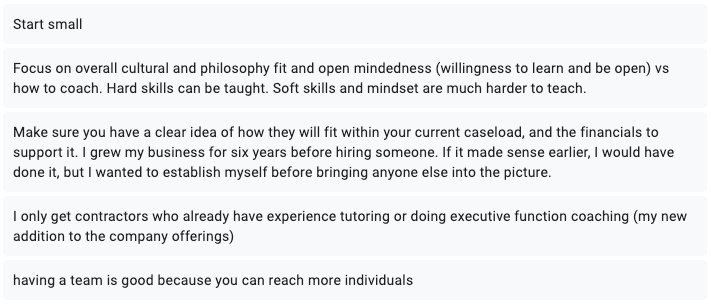
When asked,
What advice would you give to other executive function coaches who are considering hiring a team?
coaches gave a variety of answers, some being:
What Are The Challenges Of Running An Executive Function Coaching Business?
Running a business always comes with challenges. Some that EF coaches experience include:
Client retention
Managing workload
Maintaining work-life balance
Here's some specific answers given by EFCA graduates:

If you're struggling to get your business where you want it to be, EFCA offers 1:1 coaching with Sean and a community of other EF coaches, so you can avoid the “figuring it out alone” phase.
Is Executive Function Coaching a Fulfilling Career?
Career satisfaction among EFCA-certified coaches is strikingly high. The largest segment (43%) rated their satisfaction a perfect 5 out of 5.
In fact, satisfaction is so consistent that not a single coach rated their experience a 1 or 2.
Here’s some valuable advice they gave for those starting a career as an executive function coach:

Are Executive Function Coaches Continuing to Grow Their Skills?
Almost 90% of coaches say they’re pursuing or considering further training.
This is a profession that rewards continuous learning, not just for clients, but for you.
EFCA graduates often stay connected using our community for ongoing learning and support.
Or, they continue to one-on-one business coaching with me to help bring their goals to life and push through challenges.
If you're interested. in1:1 coaching, send a message to support@efcoachingacademy.com
Here are some areas that EFCA graduates noted they want to improve in their business:

The coaches who build profitable, fulfilling careers are the ones who stick with it, trust the process, and push past the limiting beliefs that try to tell them they can’t.
The Bottom Line
Here’s what you need to know about the Executive Function Coaching industry, based on real answers from EFCA graduates:
Most coaches are women aged 45–54 with backgrounds in education.
You can get your first client within 30-90 days, or even before you graduate.
Hourly rates range widely, but $100–$149/hour is common.
Monthly income varies, with some earning over $10K and others between $1-2k.
Work is usually part-time, remote or hybrid.
Client retention and marketing are the top challenges.
The majority plan to continue long-term and invest in their development.
If you're ready to get started, the next step is to apply for certification. (Takes less than 3 minutes).
Hope this helps! 🤙🏻
FAQs
Do I need to already have a background in education to become an EF coach?
No, but your previous experience can become a major advantage. The coaches in this report came from many backgrounds, including special education, tutoring, school psychology, occupational therapy, parenting, and other fields, which shows there is not one “right” path into EF coaching.
What should I focus on first if I want to make EF coaching financially sustainable?
Start by becoming excellent at delivering strong 1:1 coaching outcomes, because that is still the main revenue source for most EF coaches.
Once you have confidence, client results, and clear systems, you can expand into workshops, speaking, group coaching, consulting, or digital products.
Is executive function coaching realistic if I only want to work part-time?
Yes, and that is actually how many coaches structure their practice. The data shows that EF coaching can be a flexible business model, especially for people who want meaningful work without committing to a traditional full-time schedule.
Related Articles:
Why You Should Consider Becoming an Executive Function Coach
How Alison Eber Went From Classroom Teacher to Starting Her Own Executive Function Coaching Business
The 3 Limiting Beliefs Holding Executive Function Coaches Back
How Amy Dages Went From BCBA to Launching Her Executive Function Coaching Business in One Year
Want support in transitioning to executive function coaching?
Consider joining hundreds of educators and professionals who have completed our executive function coaching certification and are building profitable executive function coaching practices using their teaching experience.
You'll gain all the tools, templates, and techniques you'll need as a coach, plus you'll make new friends and have a community you can rely on to grow and learn. Learn more.
Here is one of our favorite reviews. You can read all recent reviews on this page.
About Me

Hey! I'm Sean 👋
I'm a former public school special education teacher who realized that executive function skills are more important than knowing when George Washington crossed the Potomac.
Since then, I've made it my mission to teach anyone who will listen about how to develop these key life skills.
In 2020, I founded Executive Function Specialists to ensure all students with ADHD and Autism have access to high-quality online executive function coaching services. We offer online EF coaching and courses to help students and families.
Realizing I could only reach so many people through coaching, in 2021 I started the Executive Function Coaching Academy which trains schools, educators, and individuals to learn the key strategies to improve executive function skills for students.
In 2023, I co-founded of UpSkill Specialists, to provide neurodivergent adults with high-quality executive function coaching services.
When not pursuing my passions through work, I love spending time with my family, getting exercise, and expanding my brain through reading. You can connect with me on LinkedIn.